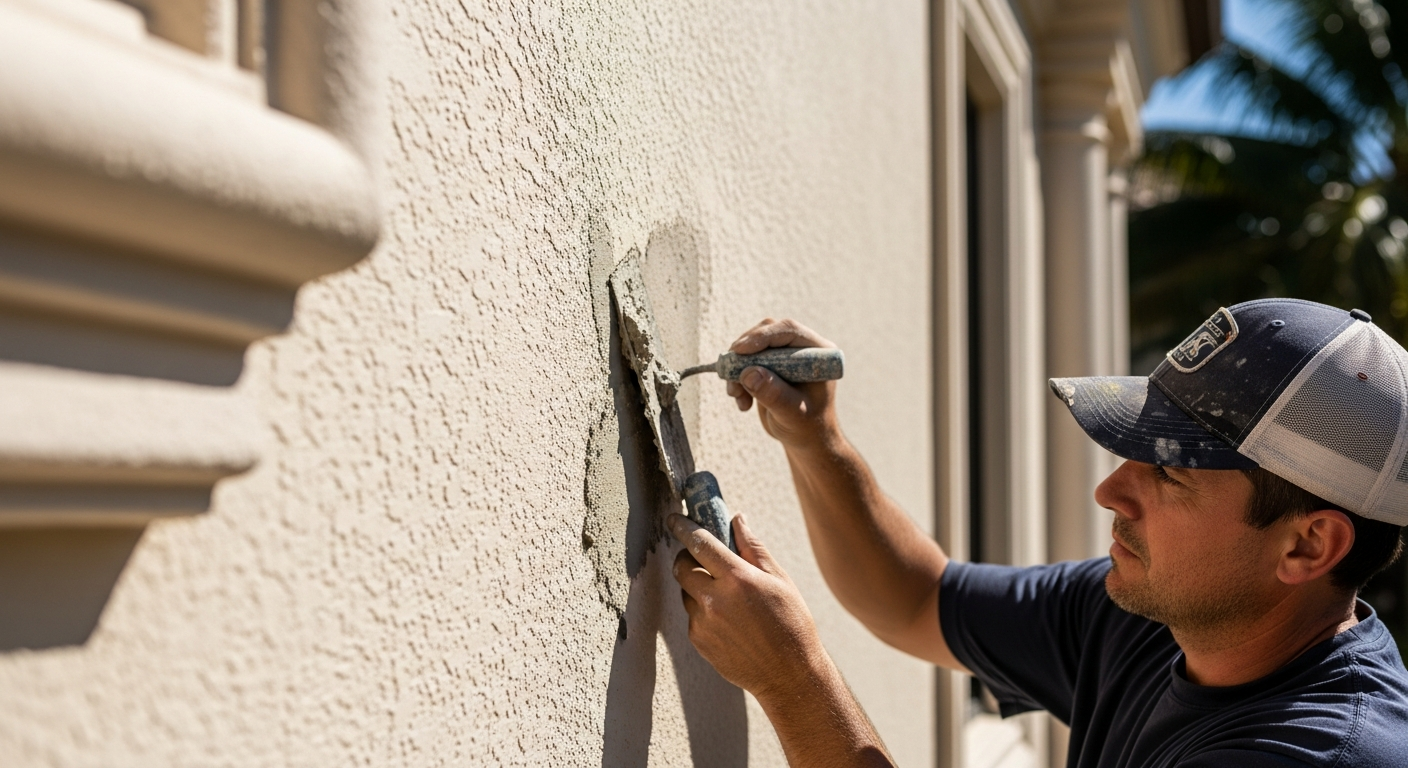
Stucco Painting & Repair in Naples, FL
Almost every home in Naples is stucco or synthetic stucco (EIFS), and stucco cracks. It's not a defect — it's what happens as concrete block construction settles and stucco expands and contracts with Florida heat. The mistake most homeowners make is treating stucco repair as optional prep work before painting. It isn't. If the cracks aren't sealed first, moisture gets behind the new coat, and you're looking at bubbling, peeling, or mold within a couple of years instead of the decade-plus a proper job should last.
As stucco painters who do the repair work ourselves, we handle stucco repair and painting as one connected process, not two separate jobs — throughout Naples, Marco Island, Bonita Springs, and Estero.
Why Stucco Fails in This Climate
UV Breakdown
Naples gets 260+ sunny days a year. That much sun bleaches and dries out stucco surfaces faster than most of the country.
Wind-driven Moisture
Summer storms drive rain into hairline cracks. Once water gets in, it doesn't dry out quickly — it lingers, softens the material underneath, and works toward mold and, eventually, the framing behind the wall.
Salt Air
Coastal and near-coastal properties see accelerated surface oxidation and coating breakdown from Gulf-driven salt air — not just waterfront homes.
Hurricane Season
Wind-driven rain penetrates hairline cracks at high velocity, and impact damage from airborne debris is common even without a direct hit. Post-storm exterior damage assessment is one of the most recurring reasons we get called, usually October through December.
Thermal Cycling
The repeated expansion and contraction of stucco through Naples' heat is a constant, low-grade stress that eventually opens hairline cracks even on well-built homes.
Reading Your Cracks — What We Check Before We Quote
Not all stucco cracks mean the same thing, and treating a structural crack like a cosmetic one is how repairs fail early:
- Hairline cracks (under 1/16").The most common type, usually caused by normal thermal cycling or minor shrinkage. These get routed out slightly and filled with a flexible patching compound — a simple caulk-over job doesn't hold up long-term because it doesn't bond into the surrounding material.
- Moderate cracks (1/16" to 1/8").Often the first visible sign of settlement or repeated water cycling behind the surface. We check for staining or softness around the crack before patching, since these are more likely to be sitting on top of an existing moisture problem than a hairline crack is.
- Structural or stair-step cracks.Diagonal cracks running from window and door corners, or stair-step patterns following the mortar joints of the block underneath, point to structural movement — not surface expansion. These need a different repair approach, and in some cases point to an issue beyond stucco itself that's worth flagging honestly rather than just patching over.
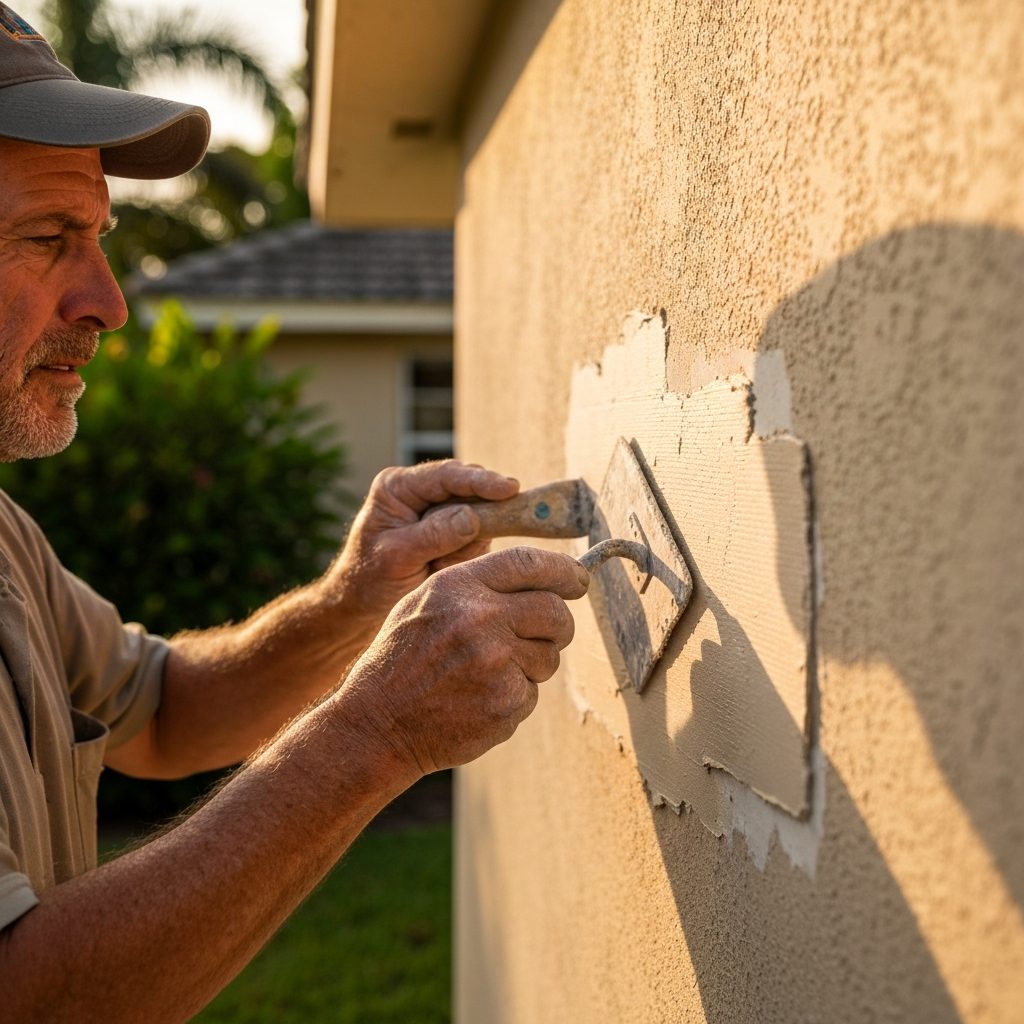
- Delamination.We sound the wall with a mallet, listening for a hollow tone that means the stucco has separated from the substrate. Hollow sections need to be cut out and patched properly, not just crack-filled — patching over a void is one of the most common reasons a "repaired" wall fails again within a year.
Traditional Stucco vs. EIFS — Why We Treat Them Differently
Traditional (hard-coat) stucco
A three-coat cement-based system — scratch coat, brown coat, and finish coat — applied over diamond-mesh lath fastened to a weather-resistant barrier on top of concrete block construction. It's rigid, breathable, and repairs are made by matching that same three-coat buildup in the damaged area.
EIFS (synthetic stucco)
A completely different system: a rigid foam insulation board with a thin base coat, fiberglass mesh, and a flexible acrylic finish coat. It's lighter and more flexible than hard-coat stucco, but it fails differently — and this matters more than most painting companies, and even some stucco companies, let on.
The Critical Distinction: Barrier vs. Drainable EIFS
Older barrier-style EIFS (common on homes and additions from before the mid-1990s) has no way for moisture that gets behind it to escape, which is exactly why EIFS earned a bad reputation nationally — trapped water rots the sheathing and framing behind the foam with no visible sign until the damage is severe. Modern drainable EIFS systems include a drainage plane specifically to solve that problem.
If your home has older EIFS sections, cracks aren't just a cosmetic issue — they're a potential entry point into a system that can't dry itself out. We probe and assess for water intrusion on EIFS repairs specifically, rather than treating a crack in EIFS the same way we'd treat a crack in hard-coat stucco — a step a lot of stucco contractors skip.
Painting Different Stucco Types in Naples
Naples Park, Golden Gate, and much of central Naples
Original three-coat hard-coat stucco over CBS block, typically 1950s–1980s construction. This is where we see the most crack repair volume, simply from material age.
Pelican Bay, Park Shore, and Vanderbilt Beach
A mix of hard-coat stucco and EIFS sections, particularly on 1980s–2000s condo and villa construction. We check which system is on the wall before quoting, since the repair approach differs.
Old Naples, Port Royal, and Aqualane Shores
Older hard-coat stucco on historic cottages alongside newer high-end rebuilds, often with multiple paint layers that need careful surface prep to avoid pulling up brittle old coatings.
Marco Island's canal-front homes
1960s–1980s original stucco with direct Gulf and canal salt exposure on nearly every elevation, not just waterfront-facing walls.
Our Stucco Repair & Paint Process
Diagnosis
We sound the wall, read the crack pattern, and check for moisture before quoting anything.
Crack and Delamination Repair
Hairline cracks get routed and filled with a flexible patching compound; delaminated sections are cut out and rebuilt to match the surrounding texture; EIFS repairs get probed for water intrusion first.
Masonry Priming
We use Sherwin-Williams Loxon Masonry Primer, formulated for high-alkalinity, high-moisture substrates — standard hard-coat and CBS stucco holds onto moisture longer than most primers are designed to handle, and Loxon is built specifically for that.
Elastomeric Coating
For coastal-exposure homes, we apply Sherwin-Williams SherLastic, an elastomeric system built to bridge hairline cracks and flex with the wall instead of cracking again with it — rated to stretch several times its original length and hold up against wind-driven rain.
New Stucco Cure Management
New stucco needs roughly 30 days to cure before painting. If the schedule can't wait that long, we prime sooner with a moisture-tolerant product rather than skipping the cure entirely and trapping moisture behind the topcoat.
Final Inspection
We walk the finished wall with you and point out exactly what was repaired and why.
What's Included
What Stucco Repair Costs in Naples
Spot Repairs
$400 to $2,500 per area
Hairline crack routing and patching, small impact damage, isolated delamination.
Mid-Scope Work
$3,500 to $12,000
Multiple elevations, larger delaminated sections, or repair tied to window flashing issues.
Full Re-Stucco
$8 to $15 per sq ft installed
One or more elevations — lath, scratch, brown, and finish coats.
EIFS repair is priced separately given the probe-testing and water-intrusion assessment involved. Plenty of stucco contractors will quote over the phone from square footage alone; we'll give you a firm number after we've actually looked at what's causing the damage.
Get your free estimateWhat You're Actually Worried About
Necessity
Is this really necessary, or are you upselling me on repair work I don't need? We'll show you what we find. Cracked or porous stucco is a visible, explainable problem — not a sales pitch.
Durability
Will the paint actually last, or will I be back here again in two years? That comes down to whether the stucco is actually sealed properly before the topcoat goes on. Most premature paint failure in Naples traces back to skipped prep, not the paint itself.
Timeline
How long does this take with Naples humidity slowing things down? Longer than a rushed job — because dry time between coats matters more here than in a drier climate. We give you a realistic timeline, not a guess.
What a Real Stucco Repair Job Looks Like
Single-family home in Naples Park, original 1960s hard-coat stucco.
Diagnose
Sounded wall, found one delaminated section + 7 cracks.
Cut & Patch
Rebuilt delaminated area (~15 sq ft) to match texture.
Cure
Patches cured fully before priming — no shortcuts.
Prime
Loxon Masonry Primer, full exterior.
Coat
2 coats SherLastic across all elevations.
| Line Item | Cost |
|---|---|
| Delamination cut-out & patch | $1,200 |
| Crack routing & sealing (7 cracks) | $850 |
| Masonry primer | $700 |
| Elastomeric coating, 2 coats | $3,200 |
| Total (6 business days) | $5,950 |
Why it cost what it did: The delaminated section costs more than a simple crack — damaged material has to come out, not just get filled over.
*Illustrative example — not a quote for your home.
Frequently Asked Questions
Ready to Deal With Your Stucco the Right Way?
Get a free estimate. We'll tell you honestly what your stucco needs — not just what color to paint it.
Need a full exterior repaint, not just stucco repair? See our Exterior Painting process →